











Technologies
Grain Sprouts' Production
Grain Sprouts' Production
Introduction
To overcome the problems of energy dependent hydroponic units like high cost of production, necessity for regular supply of electricity, fungal growth etc., ICAR-NIANP, Bangalore developed a cost-effective grain sprouts production technology on crop residue bedding. It is a modified hydroponic method and does not require electricity for sprinkling of water, as manual/battery-operated sprayer is used for spraying water.
Description of technology
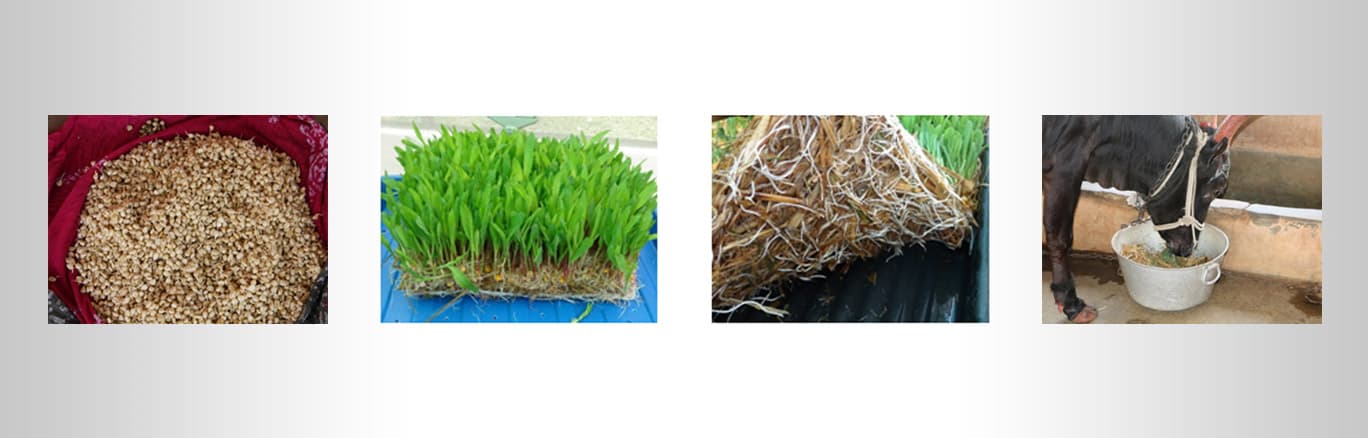
Good quality rains such as maize/wheat/cowpea/horsegram need to be cleaned with water and soaked in a bucket of water for one day. Later, grains are taken out and tightly packed in wet cloth and kept moist for 2 days in a dark place to ensure rapid germination. Germinated grains are taken out of the cloth and kept in 4% vinegar solution for about 30 minutes to prevent mould growth. Germinated grains are transferred on to the beds made of crop residues and grown for 6 days. Locally available residues like straw of paddy, wheat, finger millet, jowar, bajra etc. is to be chaffed and made into a bed of about quarter to half an inch thickness and placed in plastic trays with drain holes at the bottom. The trays are housed in a shelf like structure, secured on all sides with PVC coated galvanized iron net to prevent eating of grains by squirrels, rodents etc. The beds need to be sprinkled with water 4 times in places with moderate climate, and up to 7 times per day in hot and dry places. A spray bottle can be used for watering, if doing on a small scale. For large scale operation, battery operated knapsack sprayer costing about Rs.2,300 will be useful. On 7th day, entire straw bed with grain sprouts is taken out and fed to livestock. Production cost of maize sprouts will be about Rs.4, when maize grains are bought at Rs.15 per kg.
Economic benefits
Several KVKs tested grain sprouts production method of NIANP and found feeding 4 kg sprouts daily alleviate green fodder scarcity during the lean months. Tests done in villages by NIANP shown that supplemental feeding of 4 kg maize sprouts per cow improved milk output by 1.2 liters and net profit was at least Rs.20/day/cow.
Advantages
Any enquiry related to commercialization of the product may be made directly to the Director ICAR-NIANP ( directornianp@gmail.com )